I have been meaning to post something on Vollenhoven's "Consequent Problem-Historical Method" for a long time. Since
this post by Gideon Strauss to be exact. One of the things that has delayed this is I wanted to take seriously the criticism that Vollenhoven's method is a mere "pigeon-holing" exercise. I could just quote Seerveld, one of Vollenhoven's students who has creatively employed his method. He writes:
"The objection to Vollenhoven's "pigeon-holing" complex philosophies misunderstands his problem-historical methodology, which is deeply concessive toward all manner of thinkers from a radically christian standpoint: every slanted philosophy, from whatever "bad" neighbourhood it operates, is wrestling with God's world and cannot help but uncover matters God's children may also need to notice and realign within our own servant (not "master"!) narrative being written" ("Christian Aesthetic Bread for the World" Philosophia Reformata 2001 no.2)
I think Seerveld makes a good point, but it will only make sense when we see more analysis like his own "Pedagogical Strength" article and less like Vollenhoven's elaborate charts, meaningless to all but a few experts. I doubt the following will do much to amend this situation, but I post it anyway.
Those who would see Vollenhoven’s method as ripe for re-evaluation face the difficulty of several overlapping complexities. First and most obvious is the 80 odd conceptions and 60 odd time-currents. Secondly is that both types and time-currents, not being a priori, undergo modification and sometimes, thought not always, connected with this is that Vollenhoven's interpretation of individual thinkers also undergoes revision.
Just a cursory glance at the Schematische Kaarten (2000) raises a number of such issues: different versions of the same chart, names crossed out, names with question marks next to them, names in brackets etc. This means that the various Vollenhoven material now available do not all match up (especially the Runner translation). Bril has helpfully annotated the Kort Overzich (1956) and other material in the Vollenhoven translations to highlight these changes.
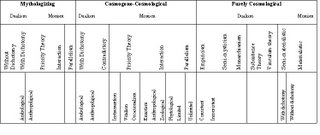
To go back a little to the types/currents complexity. 80times60=4800, the Schematische Kaarten has about 1,600 thinkers charted. So if we are to get anywhere in understanding the CPHM we have to start to simplify. There seems to be two options. The first is to follow Wolters "grid" example which gives equal weight to the three main problems (Myth/non-myth, monism/dualism, Universal/individual) and so gives us 18 conceptions. However Vollenhoven seems to order things differently, giving us a second option. A philosophers conception concerning the "vertical structure of the kingdoms" is approached according to four problems, to quote:
[1] In the first place one must consider whether someone has approached the intended structure via myth, or whether one has considered structure (while rejecting myth as a source of philosophy) in a cosmogonic-cosmological or purely cosmological way. [2] Furthermore there is the question of dualism and monism. In other words, one can think that everything is based on the eternal correlation of the transcendent and the non-transcendent, such that any unity must be explained in connection to these two categories with the result that unity is derivative. Alternatively, one can postulate that everything is at bottom a unity and consequently that any difference must be ascribed to divergence. [3] In the third place there is the problem of the vertical relationship, in dualism between the transcendent and the non-transcendent, and in monism between the higher and lower species of the original unity. [4] Finally we must determine the site within which a dualist posits the boundary between the transcendent and the non-transcendent, and in which the monist posits the single origin of everything. ("conservatism and progressiveness in Philosophy" 1959)
What we can notice is that the third "dimension" of the box is missing and is replaced by further refinement of problems arising out of the monism-dualism problematic. However this is not quite true as the issue of partial-universalism comes back, with a vengeance, in purely cosmological dualism in its attempts to solve the third problem of relating the higher and the lower. Working down these four problems then gives us, if I have worked it out correctly, 27 main types.




 'Danielson: a Family Movie'


